New AB-100 Dumps (V8.02) for Your Microsoft Certified: Agentic AI Business Solutions Architect Certification Preparation – Achieve Success in 2026

Now, you can complete your AB-100 exam to be an AI-first solution architect, leading the transformation of enterprise operations by envisioning and implementing AI-powered architecture. DumpsBase has new AB-100 dumps (V8.02) for 2026, providing the most current exam questions and verified exam answers available, ensuring you’re equipped with the knowledge and practical skills needed to pass on your first attempt and excel in this cutting-edge field. Access to these verified questions and answers that reflect the actual AB-100 exam structure. We have full confidence to help you pass the AB-100 Agentic AI Business Solutions Architect exam on your first try with comprehensive, practical knowledge.

Try before you buy with a demo version of AB-100 dumps (V8.02) to evaluate the quality:

1. A company plans to deploy an AI-based customer service app that will autonomously manage interactions, escalate complex cases, and learn from historical ticket data.

You need to perform a return on AI investment (ROAI) analysis of the app deployment. The solution must ensure that the analysis is accurate.

What should you do first?

2. Case study

This is a case study. Case studies are not timed separately from other exam sections. You can use as much exam time as you would like to complete each case study. However, there might be additional case studies or other exam sections. Manage your time to ensure that you can complete all the exam sections in the time provided. Pay attention to the Exam Progress at the top of the screen so you have sufficient time to complete any exam sections that follow this case study.

To answer the case study questions, you will need to reference information that is provided in the case. Case studies and associated questions might contain exhibits or other resources that provide more information about the scenario described in the case. Information provided in an individual question does not apply to the other questions in the case study.

A Review Screen will appear at the end of this case study. From the Review Screen, you can review and change your answers before you move to the next exam section. After you leave this case study, you will NOT be able to return to it.

To start the case study

To display the first question in this case study, select the "Next" button. To the left of the question, a menu provides links to information such as business requirements, the existing environment, and problem statements. Please read through all this information before answering any questions. When you are ready to answer a question, select the "Question" button to return to the question.

Background

Fabrikam, Inc., is a global consumer goods company that is undergoing a digital transformation initiative to migrate its entire infrastructure to the Microsoft cloud. As a key element of this cloud migration, the company will implement Microsoft Dynamics 365 Sales, moving away from the current on-premises proprietary technologies used by its business-to-business (B2B) sales team. As part of the cloud migration, Fabrikam will adopt an AI-first approach to its business solutions and implement AI solutions, wherever possible, to streamline operations.

Problem Statements

Fabrikam's infrastructure currently relies on various on-premises systems that require sales executives to use corporate computers with physical keyboards to access business information during customer interactions. Mobile phones cannot be used for these purposes, as the systems depend on keyboard input. As a result, the sales executives spend a lot of time using keyboards to search for data on several disparate systems and file servers, rather than focusing on the customers. This affects the customer experience.

Fabrikam stakeholders are concerned that users will be hesitant to adopt AI. If the AI initiatives are NOT adopted, cost savings will never be realized. Additionally, funding for future AI initiatives will depend on demonstrating an increase in AI adoption month over month. As the AI agent initiative for the sales team will be the first for Fabrikam, the rapid adoption of the agent is a high priority.

Planned Initiatives

General

Fabrikam management has prioritized AI-driven projects to improve efficiency, customer engagement, and responsible AI adoption. The current application infrastructure is on-premises and must be migrated to the cloud to support the adoption of these technologies.

Infrastructure Migration

Fabrikam plans to migrate from its current on-premises infrastructure to a completely cloud-based topology; this will include user authentication, the security framework, and, primarily, the adoption of the services by end users.

All the data from the different systems will be consolidated into a single data source - a common data model that will use a Microsoft Dataverse environment as a single source of truth (SSOT) for the sales team.

Sales Cycle Enablement

To achieve the company's objectives, Fabrikam intends to implement the following strategies to enhance the sales cycle:

Use low-code development to create a single AI agent that has Dataverse as its core component.

Ensure that sales managers can access unanswered correspondence from prospects and intervene as appropriate. Replace the previous proprietary software with Dynamics 365 Sales to track sales cycles and customer interactions. Have the sales executives use Dynamics 365 Sales to track interactions for open opportunities and send follow-up communications to prospects.

Have the sales executives use handsfree headsets to interact with an AI agent when they have questions about internal policies or customer data.

Requirements

Infrastructure Migration

Fabrikam has identified the following infrastructure migration requirements:

Azure must be used for all future infrastructure workloads.

The company must follow Microsoft-recommended methodologies for infrastructure migration to the cloud.

Any created AI agents must have their return on investment (ROI) calculated to ensure that the solution will save the company money.

Sales Cycle Enablement

Fabrikam has identified the following requirements for sales cycle enablement:

The final AI agent must follow Microsoft recommendations for a conversational user experience.

A designated checklist must be reviewed to ensure that the AI agent follows Microsoft deployment recommendations for a compliant solution.

Detailed telemetry must be logged for the first created AI agent to help troubleshoot and optimize the agent during the initial AI agent adoption process.

Unexpected AI agent actions must end in an escalation to a live representative. For example, a sales executive must be rerouted to a representative if the agent cannot answer a question after two failed attempts.

The return on investment (ROI) of switching from the current process to the future process is required for stakeholder sign off.

The sales team must use Dynamics 365 Sales to correspond with prospects more quickly and efficiently than currently.

Sales managers must report on the adoption of the AI agent to key Fabrikam stakeholders on a monthly basis. Any sensitive information, such as user IDs and names, shared via the AI agent must be tracked for future auditing.

Which tool should you use for the prospect communication requirements in Dynamics 365 Sales?

3. A company has a portfolio of AI initiatives at different stages of development.

You need to recommend a structured approach to evaluating the return on AI investment (ROAI) across all the initiatives. The solution must balance immediate results with long-term values and strategic innovations.

What should you include in the recommendation?

4. 1. HOTSPOT

Case study

This is a case study. Case studies are not timed separately from other exam sections. You can use as much exam time as you would like to complete each case study. However, there might be additional case studies or other exam sections. Manage your time to ensure that you can complete all the exam sections in the time provided. Pay attention to the Exam Progress at the top of the screen so you have sufficient time to complete any exam sections that follow this case study.

To answer the case study questions, you will need to reference information that is provided in the case. Case studies and associated questions might contain exhibits or other resources that provide more information about the scenario described in the case. Information provided in an individual question does not apply to the other questions in the case study.

A Review Screen will appear at the end of this case study. From the Review Screen, you can review and change your answers before you move to the next exam section. After you leave this case study, you will NOT be able to return to it.

To start the case study

To display the first question in this case study, select the "Next" button. To the left of the question, a menu provides links to information such as business requirements, the existing environment, and problem statements. Please read through all this information before answering any questions. When you are ready to answer a question, select the "Question" button to return to the question.

Background

Fabrikam, Inc., is a global consumer goods company that is undergoing a digital transformation initiative to migrate its entire infrastructure to the Microsoft cloud. As a key element of this cloud migration, the company will implement Microsoft Dynamics 365 Sales, moving away from the current on-premises proprietary technologies used by its business-to-business (B2B) sales team. As part of the cloud migration, Fabrikam will adopt an AI-first approach to its business solutions and implement AI solutions, wherever possible, to streamline operations.

Problem Statements

Fabrikam's infrastructure currently relies on various on-premises systems that require sales executives to use corporate computers with physical keyboards to access business information during customer interactions. Mobile phones cannot be used for these purposes, as the systems depend on keyboard input. As a result, the sales executives spend a lot of time using keyboards to search for data on several disparate systems and file servers, rather than focusing on the customers. This affects the customer experience.

Fabrikam stakeholders are concerned that users will be hesitant to adopt AI. If the AI initiatives are NOT adopted, cost savings will never be realized. Additionally, funding for future AI initiatives will depend on demonstrating an increase in AI adoption month over month. As the AI agent initiative for the sales team will be the first for Fabrikam, the rapid adoption of the agent is a high priority.

Planned Initiatives

General

Fabrikam management has prioritized AI-driven projects to improve efficiency, customer engagement, and responsible AI adoption. The current application infrastructure is on-premises and must be migrated to the cloud to support the adoption of these technologies.

Infrastructure Migration

Fabrikam plans to migrate from its current on-premises infrastructure to a completely cloud-based topology; this will include user authentication, the security framework, and, primarily, the adoption of the services by end users.

All the data from the different systems will be consolidated into a single data source - a common data model that will use a Microsoft Dataverse environment as a single source of truth (SSOT) for the sales team.

Sales Cycle Enablement

To achieve the company's objectives, Fabrikam intends to implement the following strategies to enhance the sales cycle:

Use low-code development to create a single AI agent that has Dataverse as its core component.

Ensure that sales managers can access unanswered correspondence from prospects and intervene as appropriate. Replace the previous proprietary software with Dynamics 365 Sales to track sales cycles and customer interactions. Have the sales executives use Dynamics 365 Sales to track interactions for open opportunities and send follow-up communications to prospects.

Have the sales executives use handsfree headsets to interact with an AI agent when they have questions about internal policies or customer data.

Requirements

Infrastructure Migration

Fabrikam has identified the following infrastructure migration requirements:

Azure must be used for all future infrastructure workloads.

The company must follow Microsoft-recommended methodologies for infrastructure migration to the cloud.

Any created AI agents must have their return on investment (ROI) calculated to ensure that the solution will save the company money.

Sales Cycle Enablement

Fabrikam has identified the following requirements for sales cycle enablement:

The final AI agent must follow Microsoft recommendations for a conversational user experience.

A designated checklist must be reviewed to ensure that the AI agent follows Microsoft deployment recommendations for a compliant solution.

Detailed telemetry must be logged for the first created AI agent to help troubleshoot and optimize the agent during the initial AI agent adoption process.

Unexpected AI agent actions must end in an escalation to a live representative. For example, a sales executive must be rerouted to a representative if the agent cannot answer a question after two failed attempts.

The return on investment (ROI) of switching from the current process to the future process is required for stakeholder sign off.

The sales team must use Dynamics 365 Sales to correspond with prospects more quickly and efficiently than currently.

Sales managers must report on the adoption of the AI agent to key Fabrikam stakeholders on a monthly basis.

Any sensitive information, such as user IDs and names, shared via the AI agent must be tracked for future auditing.

Which framework should you use to meet the AI agent requirements for the sales cycle enablement? To answer, select the appropriate options in the answer area. NOTE: Each correct selection is worth one point.
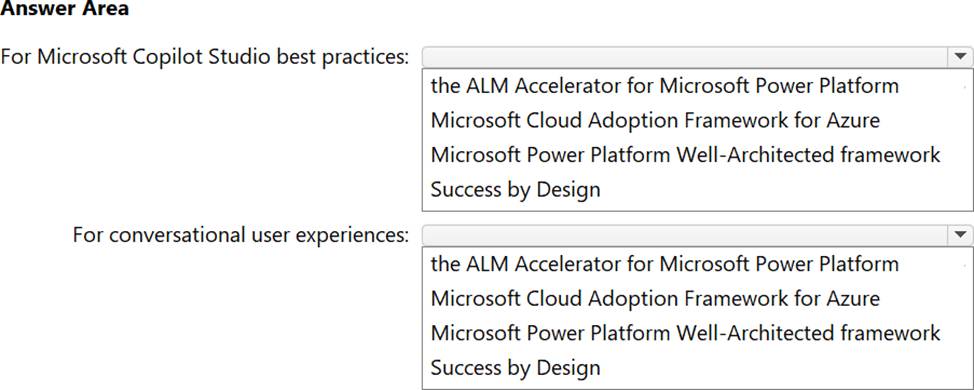

5. You need to recommend a Microsoft Power Platform business solution that consolidates data from multiple internal and external data sources.

The solution must meet the following requirements:

Provide the data as a centralized source for multiple AI systems, including Microsoft Copilot Studio agents, Dynamics 365 applications, and external AI models.

Support built-in data classification and protection policies.

Provide data for grounding and analytics.

What should you include in the recommendation?

6. A company has an AI business solution.

You need to extend the solution so that Microsoft 365 Copilot can invoke external logic hosted in Azure services.

What should you include in the solution?

7. A retail company plans to deploy Microsoft Copilot Studio agents to support:

Microsoft Dynamics 365 Commerce scenarios.

A Microsoft Power Apps inventory management solution.

You need to recommend a solution to organize product catalog data as a consistent source for multiple AI systems.

What should you recommend?

8. A company uses Microsoft Dynamics 365 finance and operations apps.

The company plans to use Microsoft Copilot in-app help and guidance to generate responses for internal business processes.

You need to add an additional knowledge source for the business processes. The solution must NOT add new topics to the Copilot agent for the finance and operations apps.

Which knowledge source should you add?

9. A company uses Microsoft Dynamics 365 Sales to manage leads that are stored in a Microsoft Dataverse table named Lead and use non-standard terminology and custom columns.

You need to configure business terms in the Lead table so that Microsoft Copilot controls can summarize the leads efficiently. The solution must minimize administrative effort.

How should you configure the business terms?

10. DRAG DROP

A company has a Microsoft Foundry project that uses a single agent and a single prompt to complete a series of tasks.

The agent encounters the following issues:

It frequently produces incomplete results.

It struggles with domain-specific reasoning.

Agent response times are remarkably slow.

You need to recommend a solution to improve the overall performance and accuracy of the agent.

What should you include in the recommendation? To answer, drag the appropriate actions to the correct requirements. Each action may be used once, more than once, or not at all. You may need to drag the split bar between panes or scroll to view content. NOTE: Each correct selection is worth one point.

11. DRAG DROP

You are designing two Microsoft Copilot Studio agents named Agent1 and Agent2.

Each agent must meet the following requirements:

Each agent must use a standard model.

Each agent must NOT use generative orchestration.

Agent1 must support simple and short phrases for a given topic.

Agent2 must integrate with Microsoft Dynamics 365 Contact Center voice channel.

You need to recommend language models for the agents.

What should you recommend for each agent? To answer, drag the appropriate language models to the correct agents. Each language model may be used once, more than once, or not at all. You may need to drag the split bar between panes or scroll to view content. NOTE: Each correct selection is worth one point.

12. Case study

This is a case study. Case studies are not timed separately from other exam sections. You can use as much exam time as you would like to complete each case study. However, there might be additional case studies or other exam sections. Manage your time to ensure that you can complete all the exam sections in the time provided. Pay attention to the Exam Progress at the top of the screen so you have sufficient time to complete any exam sections that follow this case study.

To answer the case study questions, you will need to reference information that is provided in the case. Case studies and associated questions might contain exhibits or other resources that provide more information about the scenario described in the case. Information provided in an individual question does not apply to the other questions in the case study.

A Review Screen will appear at the end of this case study. From the Review Screen, you can review and change your answers before you move to the next exam section. After you leave this case study, you will NOT be able to return to it.

To start the case study

To display the first question in this case study, select the "Next" button. To the left of the question, a menu provides links to information such as business requirements, the existing environment, and problem statements. Please read through all this information before answering any questions. When you are ready to answer a question, select the "Question" button to return to the question.

Background

Fabrikam, Inc., is a global consumer goods company that is undergoing a digital transformation initiative to migrate its entire infrastructure to the Microsoft cloud. As a key element of this cloud migration, the company will implement Microsoft Dynamics 365 Sales, moving away from the current on-premises proprietary technologies used by its business-to-business (B2B) sales team. As part of the cloud migration, Fabrikam will adopt an AI-first approach to its business solutions and implement AI solutions, wherever possible, to streamline operations.

Problem Statements

Fabrikam's infrastructure currently relies on various on-premises systems that require sales executives to use corporate computers with physical keyboards to access business information during customer interactions. Mobile phones cannot be used for these purposes, as the systems depend on keyboard input. As a result, the sales executives spend a lot of time using keyboards to search for data on several disparate systems and file servers, rather than focusing on the customers. This affects the customer experience.

Fabrikam stakeholders are concerned that users will be hesitant to adopt AI. If the AI initiatives are NOT adopted, cost savings will never be realized. Additionally, funding for future AI initiatives will depend on demonstrating an increase in AI adoption month over month. As the AI agent initiative for the sales team will be the first for Fabrikam, the rapid adoption of the agent is a high priority.

Planned Initiatives

General

Fabrikam management has prioritized AI-driven projects to improve efficiency, customer engagement, and responsible AI adoption. The current application infrastructure is on-premises and must be migrated to the cloud to support the adoption of these technologies.

Infrastructure Migration

Fabrikam plans to migrate from its current on-premises infrastructure to a completely cloud-based topology; this will include user authentication, the security framework, and, primarily, the adoption of the services by end users.

All the data from the different systems will be consolidated into a single data source - a common data model that will use a Microsoft Dataverse environment as a single source of truth (SSOT) for the sales team.

Sales Cycle Enablement

To achieve the company's objectives, Fabrikam intends to implement the following strategies to enhance the sales cycle:

Use low-code development to create a single AI agent that has Dataverse as its core component.

Ensure that sales managers can access unanswered correspondence from prospects and intervene as appropriate. Replace the previous proprietary software with Dynamics 365 Sales to track sales cycles and customer interactions. Have the sales executives use Dynamics 365 Sales to track interactions for open opportunities and send follow-up communications to prospects.

Have the sales executives use handsfree headsets to interact with an AI agent when they have questions about internal policies or customer data.

Requirements

Infrastructure Migration

Fabrikam has identified the following infrastructure migration requirements:

Azure must be used for all future infrastructure workloads.

The company must follow Microsoft-recommended methodologies for infrastructure migration to the cloud.

Any created AI agents must have their return on investment (ROI) calculated to ensure that the solution will save the company money.

Sales Cycle Enablement

Fabrikam has identified the following requirements for sales cycle enablement:

The final AI agent must follow Microsoft recommendations for a conversational user experience.

A designated checklist must be reviewed to ensure that the AI agent follows Microsoft deployment recommendations for a compliant solution.

Detailed telemetry must be logged for the first created AI agent to help troubleshoot and optimize the agent during the initial AI agent adoption process.

Unexpected AI agent actions must end in an escalation to a live representative. For example, a sales executive must be rerouted to a representative if the agent cannot answer a question after two failed attempts.

The return on investment (ROI) of switching from the current process to the future process is required for stakeholder sign off.

The sales team must use Dynamics 365 Sales to correspond with prospects more quickly and efficiently than currently.

Sales managers must report on the adoption of the AI agent to key Fabrikam stakeholders on a monthly basis.

Any sensitive information, such as user IDs and names, shared via the AI agent must be tracked for future auditing.

Which framework should you use for the infrastructure migration?

13. A company plans to deploy a Microsoft Dynamics 365 Contact Center agent.

You need to ensure that the agent can transfer the conversation to a live customer service representative.

Which two components should you include in the solution? Each correct answer presents part of the solution. NOTE: Each correct selection is worth one point.

14. A company uses Microsoft Dynamics 365 Finance to manage accounts payable.

You are designing an AI invoice processing solution.

You need to recommend the prerequisites to configure a prebuilt copilot for accounts payable.

What should you recommend?

15. A financial services company uses Microsoft Dynamics 365 Finance.

Currently, the company's support staff manually reviews customer transaction histories to detect potential fraud cases before escalating the cases.

You need to recommend an automation solution for the review process. The solution must ensure that escalations reach a human analyst for final decision making.

What should you recommend?

16. You need to design a Microsoft 365 Copilot solution to optimize employee productivity.

The solution must meet the following requirements:

Ensure that the employees can query content stored in a subset of Microsoft SharePoint Online sites and in Teams by using natural language-based prompt actions.

Ensure that employees receive contextually relevant responses in Microsoft 365 Copilot.

What should you include in the design?

17. HOTSPOT

You need to design a shared prompt library that will be used across multiple business units.

The solution must meet the following requirements:

Ensure consistent AI responses with reusable formats.

Support governance and version control.

Minimize administrative effort.

Minimize ongoing costs.

What should you recommend for each requirement? To answer, select the appropriate options in the answer area. NOTE: Each correct selection is worth one point.

18. HOTSPOT

Case study

This is a case study. Case studies are not timed separately from other exam sections. You can use as much exam time as you would like to complete each case study. However, there might be additional case studies or other exam sections. Manage your time to ensure that you can complete all the exam sections in the time provided. Pay attention to the Exam Progress at the top of the screen so you have sufficient time to complete any exam sections that follow this case study.

To answer the case study questions, you will need to reference information that is provided in the case. Case studies and associated questions might contain exhibits or other resources that provide more information about the scenario described in the case. Information provided in an individual question does not apply to the other questions in the case study.

A Review Screen will appear at the end of this case study. From the Review Screen, you can review and change your answers before you move to the next exam section. After you leave this case study, you will NOT be able to return to it.

To start the case study

To display the first question in this case study, select the "Next" button. To the left of the question, a menu provides links to information such as business requirements, the existing environment, and problem statements. Please read through all this information before answering any questions. When you are ready to answer a question, select the "Question" button to return to the question.

Background

Fabrikam, Inc., is a global consumer goods company that is undergoing a digital transformation initiative to migrate its entire infrastructure to the Microsoft cloud. As a key element of this cloud migration, the company will implement Microsoft Dynamics 365 Sales, moving away from the current on-premises proprietary technologies used by its business-to-business (B2B) sales team. As part of the cloud migration, Fabrikam will adopt an AI-first approach to its business solutions and implement AI solutions, wherever possible, to streamline operations.

Problem Statements

Fabrikam's infrastructure currently relies on various on-premises systems that require sales executives to use corporate computers with physical keyboards to access business information during customer interactions. Mobile phones cannot be used for these purposes, as the systems depend on keyboard input. As a result, the sales executives spend a lot of time using keyboards to search for data on several disparate systems and file servers, rather than focusing on the customers. This affects the customer experience.

Fabrikam stakeholders are concerned that users will be hesitant to adopt AI. If the AI initiatives are NOT adopted, cost savings will never be realized. Additionally, funding for future AI initiatives will depend on demonstrating an increase in AI adoption month over month. As the AI agent initiative for the sales team will be the first for Fabrikam, the rapid adoption of the agent is a high priority.

Planned Initiatives

General

Fabrikam management has prioritized AI-driven projects to improve efficiency, customer engagement, and responsible AI adoption. The current application infrastructure is on-premises and must be migrated to the cloud to support the adoption of these technologies.

Infrastructure Migration

Fabrikam plans to migrate from its current on-premises infrastructure to a completely cloud-based topology; this will include user authentication, the security framework, and, primarily, the adoption of the services by end users.

All the data from the different systems will be consolidated into a single data source - a common data model that will use a Microsoft Dataverse environment as a single source of truth (SSOT) for the sales team.

Sales Cycle Enablement

To achieve the company's objectives, Fabrikam intends to implement the following strategies to enhance the sales cycle:

Use low-code development to create a single AI agent that has Dataverse as its core component.

Ensure that sales managers can access unanswered correspondence from prospects and intervene as appropriate. Replace the previous proprietary software with Dynamics 365 Sales to track sales cycles and customer interactions. Have the sales executives use Dynamics 365 Sales to track interactions for open opportunities and send follow-up communications to prospects.

Have the sales executives use handsfree headsets to interact with an AI agent when they have questions about internal policies or customer data.

Requirements

Infrastructure Migration

Fabrikam has identified the following infrastructure migration requirements:

Azure must be used for all future infrastructure workloads.

The company must follow Microsoft-recommended methodologies for infrastructure migration to the cloud.

Any created AI agents must have their return on investment (ROI) calculated to ensure that the solution will save the company money.

Sales Cycle Enablement

Fabrikam has identified the following requirements for sales cycle enablement:

The final AI agent must follow Microsoft recommendations for a conversational user experience.

A designated checklist must be reviewed to ensure that the AI agent follows Microsoft deployment recommendations for a compliant solution.

Detailed telemetry must be logged for the first created AI agent to help troubleshoot and optimize the agent during the initial AI agent adoption process.

Unexpected AI agent actions must end in an escalation to a live representative. For example, a sales executive must be rerouted to a representative if the agent cannot answer a question after two failed attempts.

The return on investment (ROI) of switching from the current process to the future process is required for stakeholder sign off.

The sales team must use Dynamics 365 Sales to correspond with prospects more quickly and efficiently than currently.

Sales managers must report on the adoption of the AI agent to key Fabrikam stakeholders on a monthly basis.

Any sensitive information, such as user IDs and names, shared via the AI agent must be tracked for future auditing.

Which components should you use to meet the sales cycle enablement requirements? To answer, select the appropriate options in the answer area. NOTE: Each correct selection is worth one point.

19. A company plans to deploy a Microsoft Copilot Studio agent that will analyze historical business data to predict customer behavior.

The data is currently stored in an Azure SQL database, flat files, APIs, and logs.

You need to organize the data into a format that can be used as a knowledge source in Copilot Studio.

What should you include in the solution?

20. Case study

This is a case study. Case studies are not timed separately from other exam sections. You can use as much exam time as you would like to complete each case study. However, there might be additional case studies or other exam sections. Manage your time to ensure that you can complete all the exam sections in the time provided. Pay attention to the Exam Progress at the top of the screen so you have sufficient time to complete any exam sections that follow this case study.

To answer the case study questions, you will need to reference information that is provided in the case. Case studies and associated questions might contain exhibits or other resources that provide more information about the scenario described in the case. Information provided in an individual question does not apply to the other questions in the case study.

A Review Screen will appear at the end of this case study. From the Review Screen, you can review and change your answers before you move to the next exam section. After you leave this case study, you will NOT be able to return to it.

To start the case study

To display the first question in this case study, select the "Next" button. To the left of the question, a menu provides links to information such as business requirements, the existing environment, and problem statements. Please read through all this information before answering any questions. When you are ready to answer a question, select the "Question" button to return to the question.

Background

Fabrikam, Inc., is a global consumer goods company that is undergoing a digital transformation initiative to migrate its entire infrastructure to the Microsoft cloud. As a key element of this cloud migration, the company will implement Microsoft Dynamics 365 Sales, moving away from the current on-premises proprietary technologies used by its business-to-business (B2B) sales team. As part of the cloud migration, Fabrikam will adopt an AI-first approach to its business solutions and implement AI solutions, wherever possible, to streamline operations.

Problem Statements

Fabrikam's infrastructure currently relies on various on-premises systems that require sales executives to use corporate computers with physical keyboards to access business information during customer interactions. Mobile phones cannot be used for these purposes, as the systems depend on keyboard input. As a result, the sales executives spend a lot of time using keyboards to search for data on several disparate systems and file servers, rather than focusing on the customers. This affects the customer experience.

Fabrikam stakeholders are concerned that users will be hesitant to adopt AI. If the AI initiatives are NOT adopted, cost savings will never be realized. Additionally, funding for future AI initiatives will depend on demonstrating an increase in AI adoption month over month. As the AI agent initiative for the sales team will be the first for Fabrikam, the rapid adoption of the agent is a high priority.

Planned Initiatives

General

Fabrikam management has prioritized AI-driven projects to improve efficiency, customer engagement, and responsible AI adoption. The current application infrastructure is on-premises and must be migrated to the cloud to support the adoption of these technologies.

Infrastructure Migration

Fabrikam plans to migrate from its current on-premises infrastructure to a completely cloud-based topology; this will include user authentication, the security framework, and, primarily, the adoption of the services by end users.

All the data from the different systems will be consolidated into a single data source - a common data model that will use a Microsoft Dataverse environment as a single source of truth (SSOT) for the sales team.

Sales Cycle Enablement

To achieve the company's objectives, Fabrikam intends to implement the following strategies to enhance the sales cycle:

Use low-code development to create a single AI agent that has Dataverse as its core component.

Ensure that sales managers can access unanswered correspondence from prospects and intervene as appropriate. Replace the previous proprietary software with Dynamics 365 Sales to track sales cycles and customer interactions. Have the sales executives use Dynamics 365 Sales to track interactions for open opportunities and send follow-up communications to prospects.

Have the sales executives use handsfree headsets to interact with an AI agent when they have questions about internal policies or customer data.

Requirements

Infrastructure Migration

Fabrikam has identified the following infrastructure migration requirements:

Azure must be used for all future infrastructure workloads.

The company must follow Microsoft-recommended methodologies for infrastructure migration to the cloud.

Any created AI agents must have their return on investment (ROI) calculated to ensure that the solution will save the company money.

Sales Cycle Enablement

Fabrikam has identified the following requirements for sales cycle enablement:

The final AI agent must follow Microsoft recommendations for a conversational user experience.

A designated checklist must be reviewed to ensure that the AI agent follows Microsoft deployment recommendations for a compliant solution.

Detailed telemetry must be logged for the first created AI agent to help troubleshoot and optimize the agent during the initial AI agent adoption process.

Unexpected AI agent actions must end in an escalation to a live representative. For example, a sales executive must be rerouted to a representative if the agent cannot answer a question after two failed attempts.

The return on investment (ROI) of switching from the current process to the future process is required for stakeholder sign off.

The sales team must use Dynamics 365 Sales to correspond with prospects more quickly and efficiently than currently.

Sales managers must report on the adoption of the AI agent to key Fabrikam stakeholders on a monthly basis.

Any sensitive information, such as user IDs and names, shared via the AI agent must be tracked for future auditing.

Which template should you use for the AI agent to meet the requirements for the sales executives?


Microsoft AB-731 Dumps (V8.02) for AI Transformation Leader Exam Preparation - Pass Your AB-731 Exam with DumpsBase
Tags:

Add a Comment

Your email address will not be published. Required fields are marked *