Microsoft DP-300 Dumps Updated (V20.02) – Read DP-300 Free Dumps (Part 1, Q1-Q40) to Verify the Updated Version

You may want to pass the DP-300 exam and earn the Microsoft Certified: Azure Database Administrator Associate certification, aiming to enhance your career prospects in today’s competitive technology market. But how? You can come to DumpsBase and choose the most updated DP-300 dumps (V20.02) as the learning resources. To maximize your chances of first-attempt success, you can use the most updated dumps and learn all 366 practice questions and answers. This is a comprehensive solution to prepare for your Administering Microsoft Azure SQL Solutions DP-300 exam. By choosing reliable and current DP-300 dumps, you can approach the DP-300 exam with confidence and secure your certification investment in your professional future. Today, we will share our free demos of V20.02 to help you check the quality.

Below are the DP-300 free dumps (Part 1, Q1-Q40) of V20.02 for reading:

1. You have SQL Server 2019 on an Azure virtual machine that runs Windows Server 2019. The virtual machine has 4 vCPUs and 28 GB of memory.

You scale up the virtual machine to 8 vCPUSs and 64 GB of memory.

You need to provide the lowest latency for tempdb.

What is the total number of data files that tempdb should contain?

2. DRAG DROP

You have an Azure SQL database that contains a table named Employees. Employees contains a column named Salary.

You need to encrypt the Salary column. The solution must prevent database administrators from reading the data in the Salary column and must provide the most secure encryption.

Which three actions should you perform in sequence? To answer, move the appropriate actions from the list of actions to the answer area and arrange them in the correct order.

3. You plan to move two 100-GB databases to Azure.

You need to dynamically scale resources consumption based on workloads. The solution must minimize downtime during scaling operations.

What should you use?

4. You have an Azure Synapse Analytics Apache Spark pool named Pool1.

You plan to load JSON files from an Azure Data Lake Storage Gen2 container into the tables in Pool1.

The structure and data types vary by file.

You need to load the files into the tables. The solution must maintain the source data types.

What should you do?

5. Topic 2, Contoso Ltd

Case study

Overview

This is a case study. Case studies are not timed separately. You can use as much exam time as you would like to complete each case. However, there may be additional case studies and sections on this exam. You must manage your time to ensure that you are able to complete all questions included on this exam in the time provided.

To answer the questions included in a case study, you will need to reference information that is provided in the case study. Case studies might contain exhibits and other resources that provide more information about the scenario that is described in the case study. Each question is independent of the other questions in this case study.

At the end of this case study, a review screen will appear. This screen allows you to review your answers and to make changes before you move to the next section of the exam. After you begin a new section, you cannot return to this section.

To start the case study

To display the first question in this case study, click the Next button. Use the buttons in the left pane to explore the content of the case study before you answer the questions. Clicking these buttons displays information such as business requirements, existing environment, and problem statements. If the case study has an All Information tab, note that the information displayed is identical to the information displayed on the subsequent tabs. When you are ready to answer a question, click the Question button to return to the question.

Overview

Existing Environment

Contoso, Ltd. is a financial data company that has 100 employees. The company delivers financial data to customers.

Active Directory

Contoso has a hybrid Azure Active Directory (Azure AD) deployment that syncs to on-premises Active Directory.

Database Environment

Contoso has SQL Server 2017 on Azure virtual machines shown in the following table.

SQL1 and SQL2 are in an Always On availability group and are actively queried. SQL3 runs jobs, provides historical data, and handles the delivery of data to customers.

The on-premises datacenter contains a PostgreSQL server that has a 50-TB database.

Current Business Model

Contoso uses Microsoft SQL Server Integration Services (SSIS) to create flat files for customers. The customers receive the files by using FTP.

Requirements

Planned Changes

Contoso plans to move to a model in which they deliver data to customer databases that run as platform as a service (PaaS) offerings. When a customer establishes a service agreement with Contoso, a separate resource group that contains an Azure SQL database will be provisioned for the customer. The database will have a complete copy of the financial data. The data to which each customer will have access will depend on the service agreement tier. The customers can change tiers by changing their service agreement.

The estimated size of each PaaS database is 1 TB.

Contoso plans to implement the following changes:

Move the PostgreSQL database to Azure Database for PostgreSQL during the next six months.

Upgrade SQL1, SQL2, and SQL3 to SQL Server 2019 during the next few months.

Start onboarding customers to the new PaaS solution within six months.

Business Goals

Contoso identifies the following business requirements:

Use built-in Azure features whenever possible.

Minimize development effort whenever possible.

Minimize the compute costs of the PaaS solutions.

Provide all the customers with their own copy of the database by using the PaaS solution. Provide the customers with different table and row access based on the customer’s service agreement.

In the event of an Azure regional outage, ensure that the customers can access the PaaS solution with minimal downtime. The solution must provide automatic failover.

Ensure that users of the PaaS solution can create their own database objects but he prevented from modifying any of the existing database objects supplied by Contoso.

Technical Requirements

Contoso identifies the following technical requirements:

Users of the PaaS solution must be able to sign in by using their own corporate Azure AD credentials or have Azure AD credentials supplied to them by Contoso. The solution must avoid using the internal Azure AD of Contoso to minimize guest users.

All customers must have their own resource group, Azure SQL server, and Azure SQL database. The deployment of resources for each customer must be done in a consistent fashion.

Users must be able to review the queries issued against the PaaS databases and identify any new objects created.

Downtime during the PostgreSQL database migration must be minimized.

Monitoring Requirements

Contoso identifies the following monitoring requirements:

Notify administrators when a PaaS database has a higher than average CPU usage.

Use a single dashboard to review security and audit data for all the PaaS databases.

Use a single dashboard to monitor query performance and bottlenecks across all the PaaS databases.

Monitor the PaaS databases to identify poorly performing queries and resolve query performance issues automatically whenever possible.

PaaS Prototype

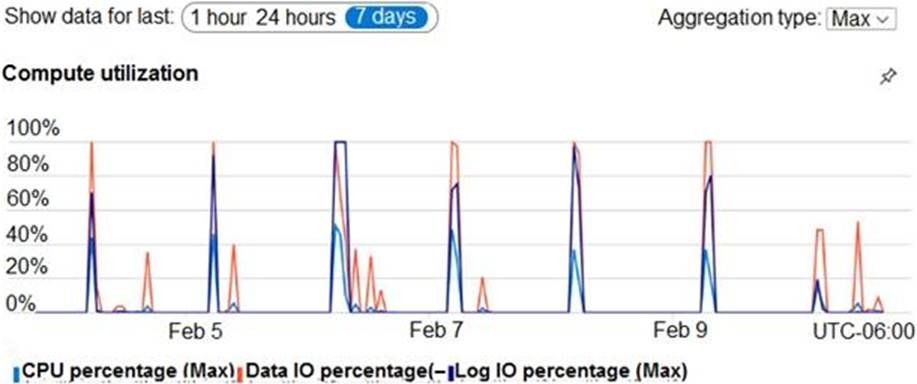
During prototyping of the PaaS solution in Azure, you record the compute utilization of a customer’s Azure SQL database as shown in the following exhibit.
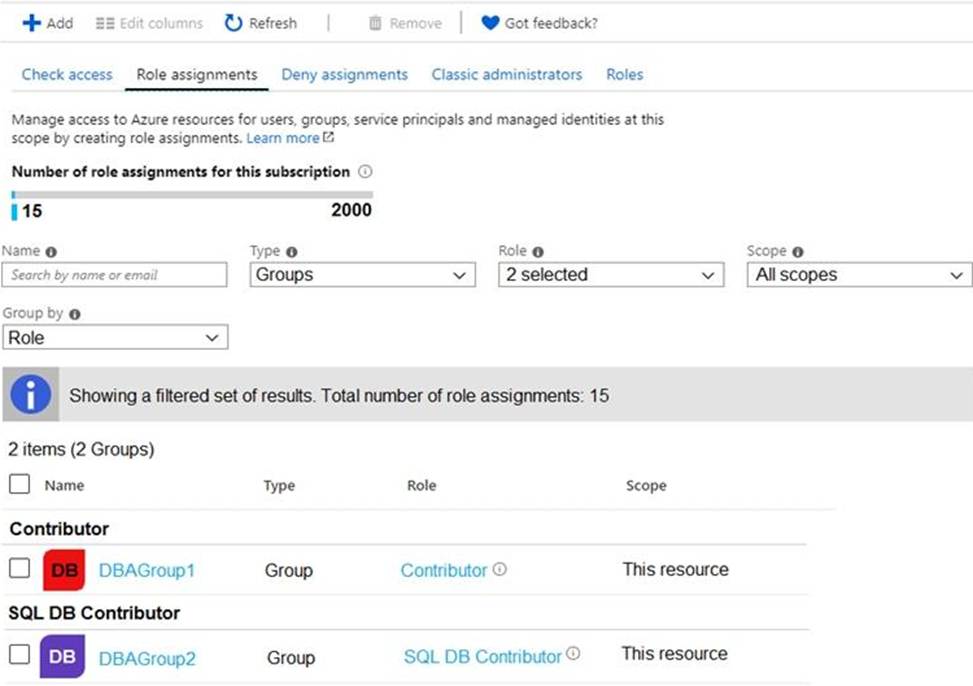
Role Assignments

For each customer’s Azure SQL Database server, you plan to assign the roles shown in the following exhibit.
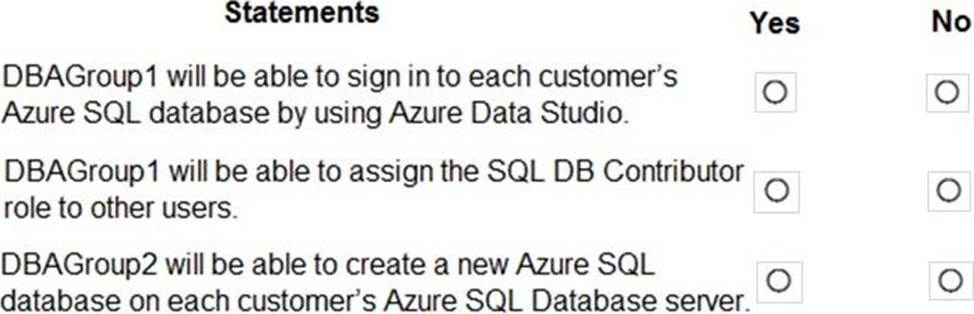
HOTSPOT

You are evaluating the role assignments.

For each of the following statements, select Yes if the statement is true. Otherwise, select No. NOTE: Each correct selection is worth one point.
6. You have the following Transact-SQL query.

Which column returned by the query represents the free space in each file?

7. You are evaluating the business goals.

Which feature should you use to provide customers with the required level of access based on their service agreement?

8. Topic 5, Lab / Simulation Tasks

SIMULATION

Task 1

In an Azure SQL database named db1, you need to enable page compression on the PK_SalesOrderHeader_SalesOrderlD clustered index of the SalesLT.SalesOrderHeader table.

9. DRAG DROP

You are building an Azure virtual machine.

You allocate two 1-TiB, P30 premium storage disks to the virtual machine. Each disk provides 5,000 IOPS.

You plan to migrate an on-premises instance of Microsoft SQL Server to the virtual machine. The instance has a database that contains a 1.2-TiB data file. The database requires 10,000 IOPS.

You need to configure storage for the virtual machine to support the database.

Which three objects should you create in sequence? To answer, move the appropriate objects from the list of objects to the answer area and arrange them in the correct order.

10. DRAG DROP

You have a resource group named App1Dev that contains an Azure SQL Database server named DevServer1. DevServer1 contains an Azure SQL database named DB1. The schema and permissions for DB1 are saved in a Microsoft SQL Server Data Tools (SSDT) database project.

You need to populate a new resource group named App1Test with the DB1 database and an Azure SQL Server named TestServer1. The resources in App1Test must have the same configurations as the resources in App1Dev.

Which four actions should you perform in sequence? To answer, move the appropriate actions from the list of actions to the answer area and arrange them in the correct order.

11. You have 50 Azure SQL databases.

You need to notify the database owner when the database settings, such as the database size and pricing tier, are modified in Azure.

What should you do?

12. What should you do after a failover of SalesSQLDb1 to ensure that the database remains accessible to SalesSQLDb1App1?

13. HOTSPOT

You plan to develop a dataset named Purchases by using Azure Databricks.

Purchases will contain the following columns:

✑ ProductID

✑ ItemPrice

✑ LineTotal

✑ Quantity

✑ StoreID

✑ Minute

✑ Month

✑ Hour

✑ Year

✑ Day

You need to store the data to support hourly incremental load pipelines that will vary for each StoreID. The solution must minimize storage costs.

How should you complete the code? To answer, select the appropriate options in the answer area. NOTE: Each correct selection is worth one point.

14. You have an Always On availability group deployed to Azure virtual machines. The availability group contains a database named DB1 and has two nodes named SQL1 and SQL2. SQL1 is the primary replica.

You need to initiate a full backup of DB1 on SQL2.

Which statement should you run?

15. You have an Azure virtual machine named VM1 on a virtual network named VNet1. Outbound traffic from VM1 to the internet is blocked.

You have an Azure SQL database named SqlDb1 on a logical server named SqlSrv1.

You need to implement connectivity between VM1 and SqlDb1 to meet the following requirements:

✑ Ensure that all traffic to the public endpoint of SqlSrv1 is blocked.

✑ Minimize the possibility of VM1 exfiltrating data stored in SqlDb1.

What should you create on VNet1?

16. HOTSPOT

You have an Azure Synapse Analytics dedicated SQL pool named Pool1 and an Azure Data Lake Storage Gen2 account named Account1.

You plan to access the files in Account1 by using an external table.

You need to create a data source in Pool1 that you can reference when you create the external table.

How should you complete the Transact-SQL statement? To answer, select the appropriate options in the answer area. NOTE: Each correct selection is worth one point.

17. You have 40 Azure SQL databases, each for a different customer. All the databases reside on the same Azure SQL Database server.

You need to ensure that each customer can only connect to and access their respective database.

Which two actions should you perform? Each correct answer presents part of the solution. NOTE: Each correct selection is worth one point.

18. HOTSPOT

You plan to deploy Instance1 by using the following script.

You need to specify the license Type and storagenedundancy parameters. The deployment must meet the availability requirements and the business requirements for DB1 and DB2.

To what should you set each parameter? To answer, select the appropriate options in the answer area.

19. Note: This question is part of a series of questions that present the same scenario. Each question in the series contains a unique solution that might meet the stated goals. Some question sets might have more than one correct solution, while others might not have a correct solution.

After you answer a question in this section, you will NOT be able to return to it. As a result, these questions will not appear in the review screen.

You have an Azure SQL database named Sales.

You need to implement disaster recovery for Sales to meet the following requirements:

✑ During normal operations, provide at least two readable copies of Sales.

✑ Ensure that Sales remains available if a datacenter fails.

Solution: You deploy an Azure SQL database that uses the General Purpose service tier and failover groups.

Does this meet the goal?

20. DRAG DROP

You have an Azure SQL Database instance named DatabaseA on a server named Server1.

You plan to add a new user named App1 to DatabaseA and grant App1 db_datacenter permissions.

App1 will use SQL Server Authentication.

You need to create App1. The solution must ensure that App1 can be given access to other databases by using the same credentials.

Which three actions should you perform in sequence? To answer, move the appropriate actions from the list of actions to the answer area and arrange them in the correct order.

21. You need to recommend a solution to ensure that the customers can create the database objects.

The solution must meet the business goals.

What should you include in the recommendation?

22. HOTSPOT

You are building a database in an Azure Synapse Analytics serverless SQL pool.

You have data stored in Parquet files in an Azure Data Lake Storage Gen2 container.

Records are structured as shown in the following sample.

The records contain two applicants at most.

You need to build a table that includes only the address fields.

How should you complete the Transact-SQL statement? To answer, select the appropriate options in the answer area. NOTE: Each correct selection is worth one point.

23. You need to identify the event_file target for monitonng DB3 after the migration to Azure SQL Database. The solution must meet the management requirements.

What should you use as the event_file target?

24. You have several Azure SQL databases on the same Azure SQL Database server in a resource group named ResourceGroup1.

You must be alerted when CPU usage exceeds 80 percent for any database. The solution must apply to any additional databases that are created on the Azure SQL server.

Which resource type should you use to create the alert?

25. You have an on-premises app named App1 that stores data in an on-premises Microsoft SQL Server 2016 database named DB1.

You plan to deploy additional instances of App1 to separate Azure regions. Each region will have a separate instance of App1 and DB1. The separate instances of DB1 will sync by using Azure SQL Data Sync.

You need to recommend a database service for the deployment. The solution must minimize administrative effort.

What should you include in the recommendation?

26. You have an Azure SQL Database server named sqlsrv1 that hosts 10 Azure SQL databases.

The databases perform slower than expected.

You need to identify whether the performance issue relates to the use of tempdb on sqlsrv1.

What should you do?

27. You need to recommend a solution that will enable remote developers to access DB1 and DB2. The solution must support the planned changes and meet the secunty requirements.

What should you include in the recommendation?

28. SIMULATION

Task 11

You have a legacy application written for Microsoft SQL Server 2012. The application will be the only application that accesses db1 You need to ensure that db1 is compatible with all the features and syntax of SQL Server 2012.

29. Which counter should you monitor for real-time processing to meet the technical requirements?

30. You are building a database backup solution for a SQL Server database hosted on an Azure virtual machine.

In the event of an Azure regional outage, you need to be able to restore the database backups. The solution must minimize costs.

Which type of storage accounts should you use for the backups?

31. You are planning disaster recovery for the failover group of an Azure SQL Database managed instance.

Your company’s SLA requires that the database in the failover group become available as quickly as possible if a major outage occurs.

You set the Read/Write failover policy to Automatic.

What are two results of the configuration? Each correct answer presents a complete solution. NOTE: Each correct selection is worth one point.

32. You have a new Azure SQL database. The database contains a column that stores confidential information.

You need to track each time values from the column are returned in a query. The tracking information must be stored for 365 days from the date the query was executed.

Which three actions should you perform? Each correct answer presents part of the solution. NOTE: Each correct selection is worth one point.

33. You have a version-8.0 Azure Database for MySQL database.

You need to identify which database queries consume the most resources.

Which tool should you use?

34. You need to identify the event_flle target for monitonng DB3 after the migration to Azure SQL Database. The solution must meet the management requirements.

What should you use as the event_file target?

35. HOTSPOT

You need to recommend which service and target endpoint to use when migrating the databases from SVR1 to Instance1. The solution must meet the availability requirements.

What should you recommend? To answer, select the appropriate options in the answer area. NOTE Each correct selection is worth one point.

36. SIMULATION

Task 7

You plan to create an automation runbook that will create database users in db1 from Azure AD identities. You need to configure sq1370O6895 to support the creation of new database users.

37. You need to implement the surrogate key for the retail store table. The solution must meet the sales transaction dataset requirements.

What should you create?

38. SIMULATION

Task 12

You need to configure high availability for dbl. The solution must tolerate the loss of an Azure datacenter without data loss or the need to modify application connection strings.

39. HOTSPOT

You have an on-premises Microsoft SQL Server 2016 server named Server1 that contains a database named DB1.

You need to perform an online migration of DB1 to an Azure SQL Database managed instance by using Azure Database Migration Service.

How should you configure the backup of DB1? To answer, select the appropriate options in the answer area. NOTE: Each correct selection is worth one point.

40. You have an Azure virtual machine named VM1 on a virtual network named VNet1. Outbound traffic from VM1 to the internet is blocked.

You have an Azure SQL database named SqlDb1 on a logical server named SqlSrv1.

You need to implement connectivity between VM1 and SqlDb1 to meet the following requirements:

✑ Ensure that VM1 cannot connect to any Azure SQL Server other than SqlSrv1.

✑ Restrict network connectivity to SqlSrv1.

What should you create on VNet1?


MB-820 Dumps Updated (V12.02) for Your Microsoft Dynamics 365 Business Central Developer Exam Preparation - Pass Successfully 2026
Tags:

Add a Comment

Your email address will not be published. Required fields are marked *