Mastering the AI-103 Microsoft Certified: Azure AI Apps and Agents Developer Associate (beta) Exam: Introducing the Newest AI-103 Practice Test (V8.02) for 2026

As a new Microsoft AI certification, the Microsoft Certified: Azure AI Apps and Agents Developer Associate (beta) is available now. This intermediate-level certification is designed specifically for AI Engineers and Developers. You need to take the AI-103 exam to validate expertise in building, managing, and deploying advanced AI agents and solutions leveraging Microsoft Foundry and Azure services. To help you master the AI-103 beta exam effectively, DumpsBase introduces the newest AI-103 practice test (V8.02), energing as a comprehensive solution for success in the 2026 exam. We have 65 practice questions in AI-103 beta (V8.02), serve as targeted preparation materials that help you review critical exam topics and practice with realistic exam-style questions. They streamline the study process by highlighting essential concepts related to developing AI applications and agents on the Azure platform. DumpsBase provides exam-focused AI-103 practice test (V8.02) 2026 designed to support you throughout your Microsoft certification journey.

Microsoft AI-103 free dumps are below for checking the quality of the newest practice test:

1. HOTSPOT -

You have a Microsoft Foundry project that contains an internal Q&A agent.

Users report the following issues when they ask the agent questions:

An increase in the following response: “No relevant information found”

Periodic HTTP 429 rate limit exceeded errors during peak hours

You need to identify whether each issue is caused by model unavailability, resource limits, or inference failures.

What should you do? To answer, select the appropriate options in the answer area. NOTE: Each correct selection is worth one point.


2. You have a Microsoft Foundry project that contains an agent. The agent uses Azure Speech in Foundry Tools.

You fine-tune a baseline speech to text model for the en-us locale and publish the model.

The agent calls the Speech to text REST API and returns an error message indicating that the project ID is invalid.

You need to set the project property to the correct ID.

To what should you set the project property?
3. DRAG DROP

You have a Microsoft Foundry project that processes procurement documents submitted by suppliers.

You need to implement two pipelines by using Azure Content Understanding in Foundry Tools.

The solution must meet the following requirements:

Include a pipeline named Pipeline1 that supports cost-effective, high-volume processing of standalone PDF invoices.

Include a pipeline named Pipeline2 that supports cross-document validation by using multi-step reasoning and reference data.

How should you configure each pipeline? To answer, drag the appropriate configurations to the correct pipelines. Each configuration may be used once, more than once, of not at all. You may need to drag the split bar between panes or scroll to view content. NOTE: Each correct selection is worth one point.


4. HOTSPOT -

Your company is piloting a customer support agent in a Microsoft Foundry project name Project1. Project1 is connected to an existing Application Insights resource, and the company’s support team reviews runs in the Traces tab.

The Foundry Agent Service is configured to perform the following actions:

Retrieve the Application Insights connection string by calling project_client.telemetry.get_application_insights_connection_string().

Call configure_azure_monitor(connection_string=...) to enable telemetry.

A separate LangChain service is configured to use OpenTelemetry and has the following configurations:

Uses AzureAIOpenTelemetryTracer(connection_string=..., enable_content_recording=False)

Passes the tracer by using config={“callbacks”:[azure_tracer]}

Company policy has the following requirements:

Telemetry from LangChain and OpenTelemetry must be distinguishable within the same Application Insights resource.

Secrets and credentials must NOT be stored in prompts, tool arguments, or span attributes.

For each of the following statements, select Yes if the statement is true. Otherwise, select No. NOTE: Each correct selection is worth one point.


5. You have a Microsoft Foundry project that contains an agent. The agent has a Model Context Protocol (MCP) tool that queries a knowledge base stored in Azure AI Search.

Some agent runs return answers from the base model without invoking the knowledge base, which results in responses without grounded citations.

You are provided with the following code snippet that runs the agent.


You need to add the correct tool _choice parameter to the code to deterministically force the agent to invoke the MCP tool on each run.

What should you add?
6. HOTSPOT -

You have a Microsoft Foundry project that contains an agent named PaymentAgent.

PaymentAgent includes a function tool that issues customer refunds by using an external API.

You are creating a workflow in YAML.

You need to ensure that the workflow pauses for human approval and continues with the refund step only after approval is granted.

How should you complete the workflow definition? To answer, select the appropriate options in the answer area. NOTE: Each correct selection is worth one point.


7. HOTSPOT

You have a Python application named App1 that integrates with a Microsoft Foundry project named Project1.

You need to ensure that App1 meets the following requirements:

Authenticates by using a Microsoft Entra managed identity

Sends prompts to a deployed model by using the Azure OpenAI Responses API

How should you complete the Python code? To answer, select the appropriate options in the answer area. NOTE: Each correct selection is worth one point.


8. You have a Microsoft Foundry project that serves a high-volume chat app.

Most requests are simple FAQs, but some require advanced reasoning.

You need to reduce costs and latency for common queries, without degrading the quality of the responses to complex questions.

What should you do?
9. You have a Microsoft Foundry project named Project1 that contains an agent. The agent uses an OpenAPI 3.0 specification to call an external weather service.

The weather service requires a key to be passed in an HTTP header. The key value is stored as a connection in Project1.

You need to ensure that the key value from the connection is included automatically whenever the OpenAPI tool is invoked.

What should you configure in the OpenAPI specification?
10. You have a Microsoft Foundry project that contains a model deployment.

You have an application that calls the deployment by using the Azure OpenAI v1 API and DefaultAzureCredential.

The developers at your company receive HTTP 403 errors when they send inference requests, even after running az login.

You need to ensure that the developers can perform model inference. The solution must follow the principle of least privilege.

Which role-based access control (RBAC) role should you assign to the developers?
11. HOTSPOT

You have a Microsoft Foundry project that contains a workflow for a customer support triage process.

You have an Ask a question node that stores user responses in a local variable named Var01.

You need to create the following Power Fx expressions:

An if/else condition expression that ensures that Var01 contains a value

A Send message expression that returns the stored user response in uppercase

How should you configure the expressions? To answer, select the appropriate options in the answer area. NOTE: Each correct selection is worth one point.


12. HOTSPOT -

You have a Microsoft Foundry project that contains an agent.

The agent uses tools to retrieve internal content and call external APIs. The agent is configured to let the model decide when to call the tools.

You need to publish the agent for a compliance workflow.

The solution must meet the following requirements:

Each workflow run must include a retrieval step before generating a response.

Tool calls must authenticate by using the published agent’s own identity.

Tool access must use an identity isolated from other project resources.

Tool access must use support audit tracing.

What should you do? To answer, select the appropriate options in the answer area. NOTE: Each correct selection is worth one point.


13. You have an Azure Speech in Foundry Tools resource that hosts a custom speech to text model deployed to a custom endpoint.

An agent uses the endpoint to perform real-time speech recognition.

You are approaching the expiration date of the custom speech to text model.

What is the expected behavior when the model expires?
14. You are planning a Microsoft Foundry project named Project1 that will contain multiple agents. Each agent will access the same Azure AI Search resource.

You need to recommend a solution to centrally manage the Azure AI Search credentials within Project1. The solution must be implemented across all the agents.

What should you recommend?
15. HOTSPOT

You have a Microsoft Foundry project that contains a customer support agent built by using the Foundry Agent Service.

The agent uploads user-provided screenshots to Azure Storage through a ticketing tool and receives a blob URL for additional reasoning.

You need to use image moderation during agent runs and prevent harmful content from being returned during runs. Azure AI Content Safety must access the images by using the blob URL. The solution must follow the principle of least privilege.

What should you configure for Content Safety? To answer, select the appropriate options in the answer area. NOTE: Each correct selection is worth one point.


16. DRAG DROP -

You have a Microsoft Foundry project that contains a customer support agent grounded in internal documentation.

After a recent update, users report the following issues:

Some answers are unsupported by retrieved documents.

A small number of responses are flagged for policy violations.

You need to evaluate each issue.

Which observability signals should you use for each issue? To answer, drag the appropriate observability signals to the correct issues. Each observability signal may be used once, more than once, or not at all. You may need to drag the spit bar between panes or scroll to view content. NOTE: Each correct selection is worth one point.


17. HOTSPOT


Case Study

This is a case study. Case studies are not timed separately from other exam sections. You can use as much exam time as you would like to complete each case study. However, there might be additional case studies or other exam sections. Manage your time to ensure that you can complete all the exam sections in the time provided. Pay attention to the Exam Progress at the top of the screen so you have sufficient time to complete any exam sections that follow this case study.


To answer the case study questions, you will bed to reference information that is provided in the case. Case studies and associated questions might contain exhibits or other resources that provide more information about the scenario described in the case. Information provided in an individual question does not apply to the other questions in the case study.


A Review Screen will appear at the end of this case study. From the Review Screen, you can review and change your answers before you move to the next exam section. After you leave this case study, you will NOT be able to return to it.


To start the case study

To display the first question in this case study, select the “Next” button. To the left of the question, a menu provides links to information such as business requirements, the existing environment, and problem statements. Please read through all this information before answering any questions. When you are ready to answer a question, select the “Question” button to return to the question.


Overview

Company Information

Contoso, Ltd is a multinational retail company that builds, deploys, and manages generative AI and agent-based solutions by using Microsoft Foundry.


Existing Environment

Identity Environment

Contoso uses Microsoft Entra ID for identity management, authentication, and authorization capabilities that enable agents to access organizational resources and services.

Contoso recently formed a new AI engineering team named Agent1Dev Team to optimize and maintain existing AI solutions. The team collaborates with solution architects, DevOps engineers, and security engineers to design, implement. monitor, and secure AI applications.

Contoso also has a team named Agent1Test Team that is responsible for validating AI solutions before the solution deployments.


Generative Environment

Contoso has a Microsoft Foundry deployment that contains two projects named Project1 and Project2.


Project1

Project1 contains a customer support agent named Agent1 that assists customers with product inquiries and troubleshooting requests.

Agent1 has the following configurations:

Agent1 uses a base model deployment.

A safety evaluation pipeline is NOT enabled.

Tool invocation approval workflows are NOT enabled.

Conversation memory constraints are NOT configured.

Agent1 interacts with customers by using digital support channels and answers general questions about Contoso products.

Project1 is deployed to an Azure region located in the European Union (EU).

Agent1Dev Team will use Project1 to optimize and maintain Agent1.


Project2

Project2 contains a deployed video generation model. The marketing department at Contoso has access to Project2 and plans to use the model to develop a video creation solution.

Development of the solution is incomplete.


Data Environment

Contoso stores product-related information in Azure resources that support AI applications.

The Azure environment contains an Azure Blob Storage account named storage1 that stores product detail sheets for all the Contoso products.

The product sheets include specifications, feature descriptions, and product support information that Agent1 can use to answer customer questions. The product sheets are stored in the PDF format.


Problem Statements

Contoso identifies the following issues:

Agent1 has only general knowledge of the Contoso products.

A recent chat interaction with Agent1 was analyzed for sentiment. The results of the analysis have NOT been processed yet. Agent1 does NOT use the detailed product information in the product sheets stored in storage1 when responding to customer questions.

The finance department at Contoso reports that vendor invoices must be reviewed manually to ensure that the invoices match the terms defined in the vendor contracts. The invoices contain tables, logos, and varied layouts that make the documents difficult to process consistently.


Requirements

Planned Changes

Contoso plans to implement the following changes:

Implement a solution for Project1 that analyzes the vendor invoices by evaluating both the visual layout and the textual content of the invoices, so that the invoice details can be verified against the vendor contract terms.

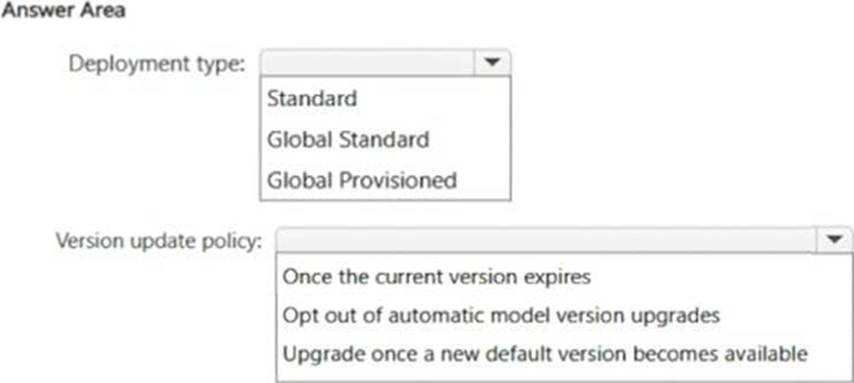
Update the base model deployment used by Agent1 and standardize the model version to ensure continuity and consistent responses.

Enable Agent1 to retrieve and use the detailed product information from the product sheets stored in storage1.

Implement an indexing solution for the product sheets that Agent1 can use to answer customer questions.

Complete the development of the video creation solution.


Technical Requirements

Contoso identifies the following technical requirements:

The model deployment used by Agent1 must support scalable, high-throughput generative AI workloads and dynamically scale to handle variable customer support traffic, without requiring reserved throughput capacity.

The product sheets must be processed by using an indexing pipeline that enables semantic and vector search, so that Agent1 can retrieve the relevant product information.

Responses generated by using the product sheet information must be relevant, complete, and accurate.

Agent1 must be able to use the product sheets to answer natural language questions about product details.

The model version used by Agent1 must remain consistent to ensure stable responses.

The data processed by the model must remain within the EU.

Security and Compliance Requirements

Contoso identifies the following security and compliance requirements:

API keys must NOT be used to access Foundry-deployed models.

Access to the Azure resources must follow the principle of least privilege.

The developers at Contoso must authenticate to Microsoft Foundry resources by using Microsoft Entra authentication. Access to Project1 must be assigned to the members of Agent1Dev Team by using a security group named SC_Agent1_Dev. Access to Project1 must be assigned to the members of Agent1Test Team by using a security group named SC_Agent1_Test. Agent1 must never reveal customer information, even if a document that contains customer data is added erroneously to the product sheet repository in storage1.

The product sheets might contain images that include embedded text. Agent1 must be protected from malicious instructions potentially hidden within the images.


Business Requirements

Contoso identifies the following business requirements:

Users that interact with Agent1 must have a personalized experience in future interactions, including the ability for Agent1 to retain conversation context and recall relevant information from previous interactions. Agent1 must answer questions only about the products sold by Contoso.


You need to configure the model deployment for Agent1 to meet the technical requirements.

What should you configure? To answer, select the appropriate options in the answer area. NOTE: Each correct selection is worth one point.


18. HOTSPOT


Case Study

This is a case study. Case studies are not timed separately from other exam sections. You can use as much exam time as you would like to complete each case study. However, there might be additional case studies or other exam sections. Manage your time to ensure that you can complete all the exam sections in the time provided. Pay attention to the Exam Progress at the top of the screen so you have sufficient time to complete any exam sections that follow this case study.


To answer the case study questions, you will bed to reference information that is provided in the case. Case studies and associated questions might contain exhibits or other resources that provide more information about the scenario described in the case. Information provided in an individual question does not apply to the other questions in the case study.


A Review Screen will appear at the end of this case study. From the Review Screen, you can review and change your answers before you move to the next exam section. After you leave this case study, you will NOT be able to return to it.


To start the case study

To display the first question in this case study, select the “Next” button. To the left of the question, a menu provides links to information such as business requirements, the existing environment, and problem statements. Please read through all this information before answering any questions. When you are ready to answer a question, select the “Question” button to return to the question.


Overview

Company Information

Contoso, Ltd is a multinational retail company that builds, deploys, and manages generative AI and agent-based solutions by using Microsoft Foundry.


Existing Environment

Identity Environment

Contoso uses Microsoft Entra ID for identity management, authentication, and authorization capabilities that enable agents to access organizational resources and services.

Contoso recently formed a new AI engineering team named Agent1Dev Team to optimize and maintain existing AI solutions. The team collaborates with solution architects, DevOps engineers, and security engineers to design, implement. monitor, and secure AI applications.

Contoso also has a team named Agent1Test Team that is responsible for validating AI solutions before the solution deployments.


Generative Environment

Contoso has a Microsoft Foundry deployment that contains two projects named Project1 and Project2.


Project1

Project1 contains a customer support agent named Agent1 that assists customers with product inquiries and troubleshooting requests.

Agent1 has the following configurations:

Agent1 uses a base model deployment.

A safety evaluation pipeline is NOT enabled.

Tool invocation approval workflows are NOT enabled.

Conversation memory constraints are NOT configured.

Agent1 interacts with customers by using digital support channels and answers general questions about Contoso products.

Project1 is deployed to an Azure region located in the European Union (EU).

Agent1Dev Team will use Project1 to optimize and maintain Agent1.


Project2

Project2 contains a deployed video generation model. The marketing department at Contoso has access to Project2 and plans to use the model to develop a video creation solution.

Development of the solution is incomplete.


Data Environment

Contoso stores product-related information in Azure resources that support AI applications.

The Azure environment contains an Azure Blob Storage account named storage1 that stores product detail sheets for all the Contoso products.

The product sheets include specifications, feature descriptions, and product support information that Agent1 can use to answer customer questions. The product sheets are stored in the PDF format.


Problem Statements

Contoso identifies the following issues:

Agent1 has only general knowledge of the Contoso products.

A recent chat interaction with Agent1 was analyzed for sentiment. The results of the analysis have NOT been processed yet. Agent1 does NOT use the detailed product information in the product sheets stored in storage1 when responding to customer questions.

The finance department at Contoso reports that vendor invoices must be reviewed manually to ensure that the invoices match the terms defined in the vendor contracts. The invoices contain tables, logos, and varied layouts that make the documents difficult to process consistently.


Requirements

Planned Changes

Contoso plans to implement the following changes:

Implement a solution for Project1 that analyzes the vendor invoices by evaluating both the visual layout and the textual content of the invoices, so that the invoice details can be verified against the vendor contract terms.

Update the base model deployment used by Agent1 and standardize the model version to ensure continuity and consistent responses.

Enable Agent1 to retrieve and use the detailed product information from the product sheets stored in storage1.

Implement an indexing solution for the product sheets that Agent1 can use to answer customer questions.

Complete the development of the video creation solution.


Technical Requirements

Contoso identifies the following technical requirements:

The model deployment used by Agent1 must support scalable, high-throughput generative AI workloads and dynamically scale to handle variable customer support traffic, without requiring reserved throughput capacity.

The product sheets must be processed by using an indexing pipeline that enables semantic and vector search, so that Agent1 can retrieve the relevant product information.

Responses generated by using the product sheet information must be relevant, complete, and accurate.

Agent1 must be able to use the product sheets to answer natural language questions about product details.

The model version used by Agent1 must remain consistent to ensure stable responses.

The data processed by the model must remain within the EU.

Security and Compliance Requirements

Contoso identifies the following security and compliance requirements:

API keys must NOT be used to access Foundry-deployed models.

Access to the Azure resources must follow the principle of least privilege.

The developers at Contoso must authenticate to Microsoft Foundry resources by using Microsoft Entra authentication. Access to Project1 must be assigned to the members of Agent1Dev Team by using a security group named SC_Agent1_Dev. Access to Project1 must be assigned to the members of Agent1Test Team by using a security group named SC_Agent1_Test. Agent1 must never reveal customer information, even if a document that contains customer data is added erroneously to the product sheet repository in storage1.

The product sheets might contain images that include embedded text. Agent1 must be protected from malicious instructions

potentially hidden within the images.


Business Requirements

Contoso identifies the following business requirements:

Users that interact with Agent1 must have a personalized experience in future interactions, including the ability for Agent1 to retain conversation context and recall relevant information from previous interactions. Agent1 must answer questions only about the products sold by Contoso.


You need to configure Agent1 to meet the security and compliance requirements.

What should you use?
19. You have a Microsoft Foundry project that contains three agents as shown in the following table.


You need to orchestrate the agents to ensure that the customer requests meet the following requirements:

Support a deterministic, step-based process that uses conditional branching and shared state across the agents.

Optionally trigger a ticket action based on the triage result.

The solution must minimize development effort.

What should you include in the solution?
20. You have a Microsoft Foundry project that contains a high-traffic agent.

After a recent update, operational costs increase significantly.

Monitoring confirms that the volume of user traffic to the agent remains unchanged.

You suspect that changes to the request or response characteristics are causing the increase. You need to identify whether the additional costs are driven by the model input size, the model output size, or expanded tool usage.

Which observability capability should you use?


PL-900 Dumps (V25.02) with the Latest PL-900 Exam Questions and Answers: Check PL-900 Free Dumps (Part 3, Q81-Q120) Today and Start Your Preparation

Add a Comment

Your email address will not be published. Required fields are marked *