CCNP Wireless is BACK! Prepare for the 2026 Independent Track & Crush 350-101 Early
It’s great that DumpsBase has released the newest 350-101 exam dumps with verified questions and correct answers for your Implementing and Operating Cisco Wireless Core Technologies (350-101 WLCOR) v1.0 exam preparation. Successfully passing the 350-101 exam will prove your specialized knowledge and practical understanding of complex Cisco wireless solutions, architectures, and automated lifecycle management. It will help you stand out in a highly competitive IT market and unlock specialized job opportunities. With access to DumpsBase 350-101 exam dumps and a focused study approach, conquering the 350-101 WLCOR exam becomes a highly achievable goal.
Cisco CCNP Wireless Is Back: A Major Comeback for the Wireless Certification Track
The Implementing and Operating Cisco Wireless Core Technologies (350-101 WLCOR) exam is the core requirement for the CCNP Wireless certification. We know that Cisco CCNP Wireless has gone through a full cycle of creation, integration, and return.
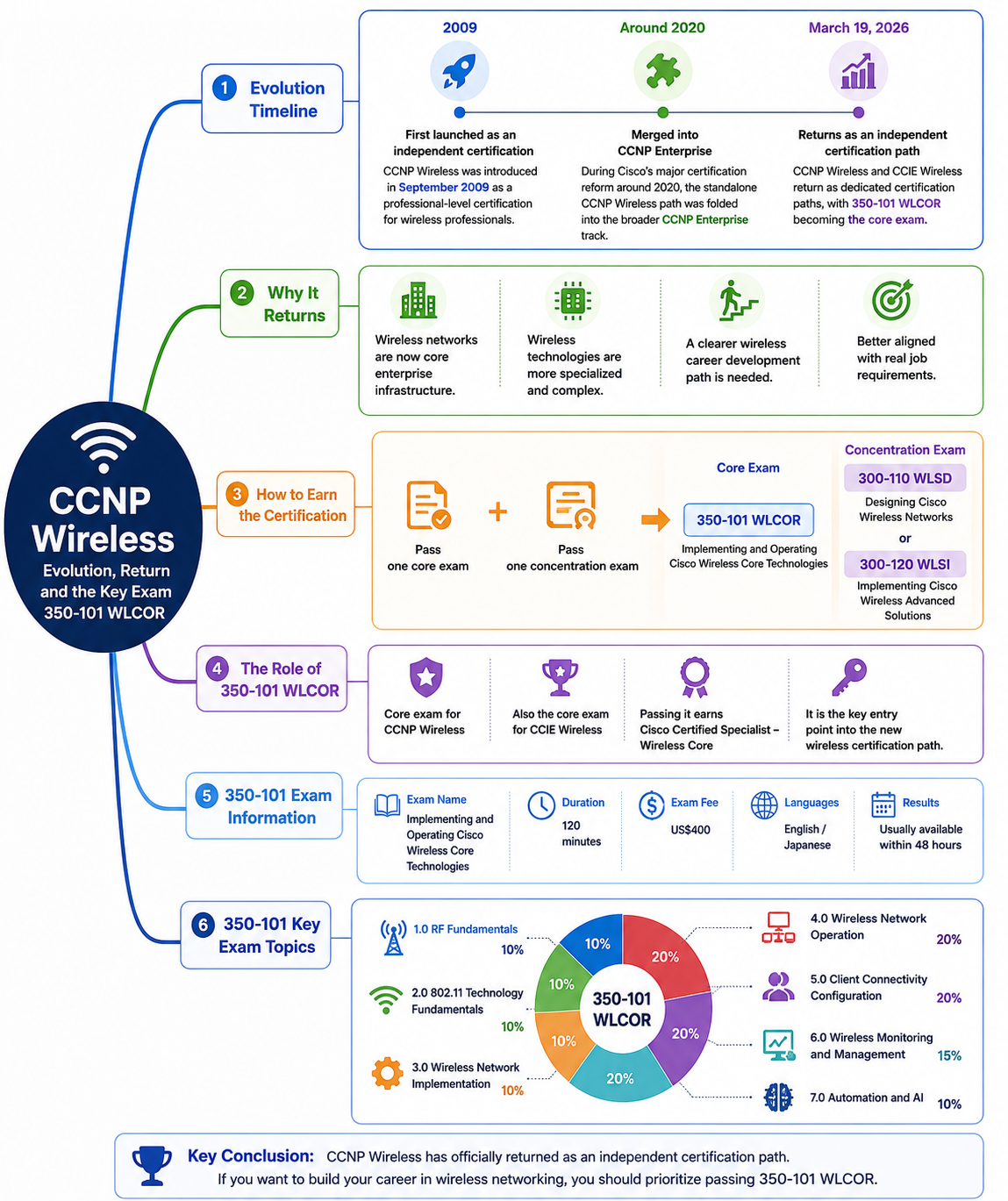
Cisco first introduced CCNP Wireless in September 2009 for wireless professionals responsible for designing, implementing, and supporting Cisco wireless networks. Around 2020, Cisco folded it into CCNP Enterprise, where wireless was covered mainly through concentration exams. Cisco has now brought back a dedicated wireless track. From March 19, 2026, CCNP Wireless and CCIE Wireless return as separate paths, and 350-101 WLCOR becomes the core exam for both.
This change shows Cisco sees wireless as its own major domain again, so preparing early for 350-101 WLCOR can give candidates a head start.
Why Cisco CCNP Wireless Is Making a Strong Return
•Wireless is now business-critical, not optional: Many organizations rely on Wi‑Fi as the primary access method for users, devices, applications, IoT endpoints, and day-to-day operations.
•Enterprise wireless has become much more complex: Modern WLANs must support high-density environments, secure onboarding, seamless roaming, guest access, location services, application performance, automation, AI-driven insights, and advanced monitoring, which goes far beyond basic WLAN configuration.
•A dedicated track better matches real job needs: Cisco states the separate wireless certification track aligns more closely with modern wireless technologies and the day-to-day challenges wireless professionals face, validating advanced design, implementation, and operations skills.
•Certification paths become clearer and more focused: When wireless was part of CCNP Enterprise, candidates had to cover broader enterprise topics even if their career focus was wireless. With CCNP Wireless separated, candidates can focus directly on wireless, and the CCNP Enterprise core will no longer include wireless concepts.
Generally, Cisco is bringing CCNP Wireless back because wireless is now too important, too specialized, and too complex to remain only a subtopic under broader enterprise networking.
Latest Requirements to Earn the New CCNP Wireless Certification (2026)
To earn the new Cisco CCNP Wireless certification, you must pass two exams:
1. One core exam: Implementing and Operating Cisco Wireless Core Technologies (350-101 WLCOR)
2. One CCNP Wireless concentration exam: Designing Cisco Wireless Networks (300-110 WLSD) or Implementing Cisco Wireless Advanced Solutions (300-120 WLSI)
Additionally, there are no formal prerequisites for CCNP Wireless. However, this is still a professional-level certification. Cisco commonly recommends that you have practical experience with enterprise networking and wireless technologies before attempting the exam. In real preparation, candidates should already understand networking fundamentals, WLAN architecture, RF basics, Cisco wireless solutions, client connectivity, network security, and troubleshooting.
350-101 WLCOR: The Core Exam That Opens the New CCNP Wireless Path
As the core exam for the 2026 new CCNP Wireless certification, the 350-101 WLCOR exam tests your knowledge of implementing core wireless technologies, including radio frequency fundamentals, 802.11 technology fundamentals, client connectivity, wireless monitoring and management, automation, and AI.
1. RF Fundamentals – 10%
RF fundamentals underpin wireless networking. Understand signal behavior, channels, and interference. Many issues come from RF design and the physical environment, not configuration. Diagnose RF conditions before troubleshooting controllers or software.
2. 802.11 Technology Fundamentals – 10%
This section covers Wi‑Fi standards and core 802.11 behavior, including how clients associate, authenticate, roam, and exchange traffic. A strong 802.11 foundation helps you diagnose common issues such as failed joins, slow roaming, and poor performance in high‑density areas.
3. Wireless Network Implementation – 10%
This section covers deploying Cisco wireless networks, configuring WLANs, and how controllers and access points work together. It also includes key settings, network services, security integration, and common deployment models used in enterprise projects.
4. Wireless Network Operation – 20%
Wireless Network Operation is one of the biggest exam domains. Cisco expects candidates to manage wireless networks after deployment, not just implement them. It covers day-to-day WLAN, controller, AP, and client behavior, plus roaming, services, performance tuning, and troubleshooting. Because it is 20% of the exam, prioritize it in your study plan.
5. Client Connectivity Configuration – 20%
Client connectivity is a major domain because many support issues are client-side. Candidates should know how clients join WLANs, how auth works, how security policies affect access, and how to troubleshoot common connection problems.
6. Wireless Monitoring and Management – 15%
Modern wireless networks need continuous monitoring and management. This domain covers visibility, management tools, troubleshooting workflows, and operational insights. Wireless engineers must spot issues, interpret telemetry, and use platforms to keep networks healthy, especially in large environments such as campuses, hospitals, hotels, warehouses, schools, and enterprise offices.
7. Automation and AI – 10%
Automation and AI highlight how modern the new CCNP Wireless track is. WLCOR may cover APIs, automation basics, Python, analytics, and AI-driven operations. Candidates are expected to go beyond CLI work and use these tools to improve efficiency, visibility, and troubleshooting.
CCNP Wireless Is No Longer Just Back — It Is Repositioned for the Future
CCNP Wireless’ return is more than a simple update: it restores wireless networking as a dedicated Cisco certification path after moving under CCNP Enterprise, reflecting how enterprise Wi‑Fi has become more business‑critical and technically demanding. For candidates, the key is to prepare early for the new 350-101 WLCOR core exam, which validates essential wireless skills, supports the CCNP Wireless credential, and serves as the gateway toward CCIE Wireless as the track relaunches in 2026.
Use Reliable 350-101 Exam Dumps for Implementing and Operating Cisco Wireless Core Technologies (WLCOR) Exam Preparation
Now you are planning to prepare for the 350-101 Implementing and Operating Cisco Wireless Core Technologies (WLCOR) exam. Using the 350-101 exam dumps is essential for true success. We have set the comprehensive exam questions and answers, which are meticulously designed to align with the latest 2026 exam structure, helping you bridge the gap between textbook concepts and real-world exam scenarios. With DumpsBase, understanding the question patterns, phrasing, and technical focus areas ensures that there are no surprises on test day.
By utilizing DumpsBase 350-101 exam dumps, you ensure that your preparation remains strictly aligned with the current 350-101 WLCOR exam requirements, drastically boosting your confidence before stepping into the final test. Strengthen your preparation today, master the wireless domain, and significantly increase your chances of passing on your very first attempt.
